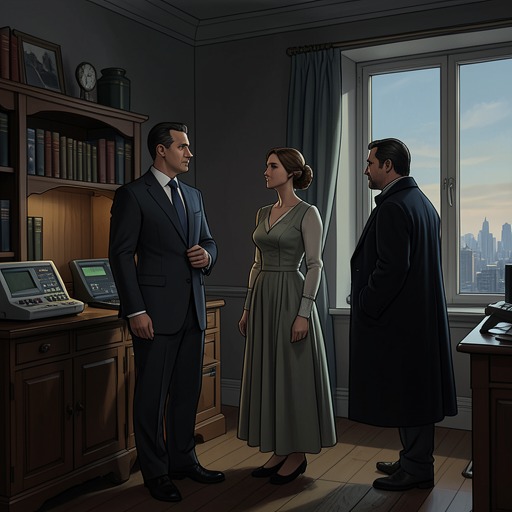
No. 16's escape and Tuppence's abduction
Partners in CrimeNo. 16's escape and Tuppence's abduction turns an apparently successful Secret Service trap into a pursuit shaped by the very disguises and assumptions the agents were watching for. The Russian operative leaves the Blitz not as the fair-bearded man and girl under surveillance, but as an invalid boy accompanied by a hospital nurse; in the process, Tuppence is removed from the hotel, drugged, and concealed among the apparent escapees. The discovery of her discarded clothes makes the capture attempt’s failure unmistakable, even as evidence that the exits are watched leaves open whether the fugitives have truly got away.
Background and the planned trap
Mr. Carter warns that a Russian agent is expected in London: a linguist and master of disguise who devised the No. 16 code and had caused trouble during the war. Carter does not know the name under which the agent will travel or when he will arrive, but anticipates that he may approach the International Detective Agency with a case and test its occupants using coded passwords. A dictaphone has been installed in the office so the Secret Service can monitor conversations and respond quickly.
The agent appears to recognize that the agency has been warned. Tommy gives the prescribed response to the second password, saying he was in Berlin on the thirteenth of the previous month. The stranger then says there is no need to continue the fiction, dismisses the supposed daughter who had accompanied him, and indicates that he knows Tommy has been alerted. The exchange suggests that Tommy’s correct performance has established contact, but has not made the agent careless or revealed the full reach of his plan.
Surveillance at the Blitz
At the Blitz, Carter arranges a close watch rather than an immediate arrest. Two of his men are in the restaurant as waiters; others are posted upstairs to watch the stranger’s suite, and more are stationed outside to follow the party. Carter also assures Tommy that Tuppence will remain under observation. When the suspected agent leaves the restaurant with the girl, Carter expects him to take her to the suite, and the men prepare to follow.
The operation’s vulnerability lies in the form of its vigilance. The watchers are alert for the man and the girl they expect to see, and a Secret Service waiter later admits that he scarcely noticed an invalid boy and a hospital nurse passing through the corridor. Their repeated presence at the hotel had made them familiar; the disguise exploited both that familiarity and the watchers’ attention to the more conspicuous pair.
The room and the missing woman
When Carter’s men enter the suite, they find a middle-aged, fashionably dressed woman bound hand and foot on an ornate rose-and-gold bedspread, gagged and visibly furious. Carter searches the room, including its wardrobe, the space beneath the bed, the chimney, and the curtains. Tommy examines the communicating door and realizes the fugitives have used it. The search moves from the visible prisoner and the apparently controlled suite to the overlooked connection with the adjoining room.
A telephone inquiry identifies the previous occupants of the suite as an invalid French boy, M. Paul de Varez, and a hospital nurse, who left that morning. One of Carter’s men recognizes that he had seen them in the passage before, but had not considered them suspicious. The crucial clue is not an unfamiliar face but a familiar-looking pair whose role had been rehearsed through repeated ordinary appearances.
Disguise, drugging, and reversal
Tommy finds a small rolled bundle beneath the sofa. Inside are Tuppence’s long black coat, walking dress, and hat, along with a long fair beard. Their presence shows how the apparent man-and-girl disguise could be shed and exchanged for the boy-and-nurse appearance. Tommy reconstructs the likely sequence: the agent used the adjoining room, silenced the woman there and Tuppence, dressed Tuppence as the boy, changed his own appearance, and left openly with her. The nurse and patient had stayed long enough for hotel staff to become accustomed to seeing them.
The bundle alone does not explain how Tuppence could have cooperated in the escape. Carter finds a small fragment of a hypodermic needle on the carpet, identifying the means by which she was drugged. Her absence is therefore not a voluntary part of Tommy’s deception: No. 16 has incapacitated and abducted her while using a disguise that allowed him to pass through the hotel under the watchers’ notice.
Consequences and significance
The hotel’s inquiries establish that the supposed nurse and invalid boy left in a taxi about five minutes earlier. Tommy concludes that No. 16 has got clear, but Carter counters that every exit is watched. Tommy objects that the surveillance was meant to catch a man and a girl, not a nurse and an invalid boy. The argument captures the reversal: the agents have guarded the routes out, yet their categories of suspicion have left the actual escape route open.
The episode makes disguise more than a change of clothes. No. 16’s success depends on controlling what the hotel staff and Secret Service expect to recognize: a familiar nurse and patient can pass where a watched criminal and his companion would draw attention. The escape also transforms the operation from an attempt to capture the agent into an urgent search for Tuppence. The available evidence ends with the pair already gone from the hotel and Carter’s men uncertain whether the watched exits can still prevent their escape.